
The Mediator Model
Between a person and their public stands a new mediator: the model. It reads, weighs and summarizes before any human decides. Whoever is not mediator-readable does not appear in the answer.

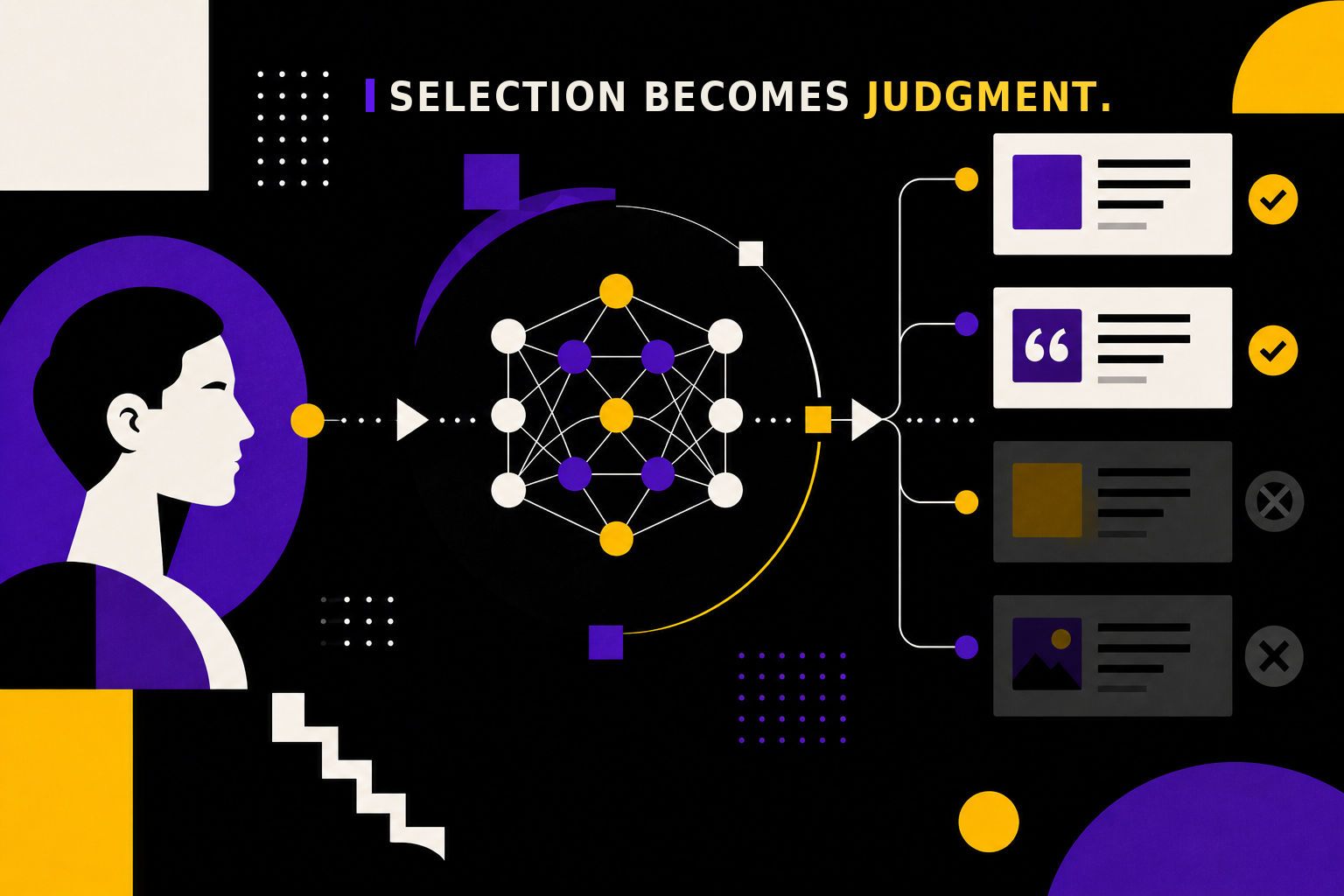
1994: the newsroom. 2004: the search engine. 2024: the model.
Someone looked you up this week. Not on Google. They asked an AI model, and the model decided what gets said about you before you could say a word.
There has always been an instance between a person and their public. The newsroom decided who made the page and who did not. It had a phone number. You could call the editor, argue, charm, push. Then the search engine decided which page sat on top. It had rules you could study, and an entire industry learned to play them. Both gatekeepers had one thing in common: you could see them, and you could work them.
The new mediator is different in kind, not in degree. The model reads you before any human does.
A search engine hands you ten links and leaves the judgment to you. The model hands you a choice already made. It picks three or four sources, orders them, retells them in its own words, and drops everything else. A framed, narrated selection, not a list.
Selection becomes judgment.
This is where most people get the model wrong. They treat it like a better search box. But a search engine shows what exists, and the model decides what makes it into the answer. The index was a map. The model is a voice giving you directions, and it skips three turns because they do not fit the route it has already chosen.
So the question is no longer how to rank. The question is what this mediator selects for.
The mediator decides who gets cited. Reach becomes the second question.
Who are the new mediators?
The new mediators are AI models and the systems that deliver them: ChatGPT, Perplexity, Google AI Overviews, Claude. They stand between a person and their public, in the place the newsroom held first and the search engine after it. They read, weigh and summarize before any human decides.
What the mediator selects for
Impressions do not count. Traces do.
Two things matter: in how many places you are named, and how consistently. One mention in an established trade outlet weighs more for how models categorize you than a hundred impressions. Not because it is louder, but because it confirms you, and to a model, confirmation by a credible third party is evidence.
Behind the answer run two layers at two speeds. The fast one, the retrieval layer, searches the live web the moment you ask and cites with a link: Perplexity, ChatGPT with search, Google AI Overviews. It reaches for thin sources more readily. The slow one is trained knowledge, baked into the model itself and updated only on retraining. It is also not uniform. Claude, ChatGPT and Gemini do not know the same things about you. One surface is never enough. You have to show up broadly to land in more than one corpus.
Across both layers, the mediator selects for three things. Findability: are you crawlable at all. Consistency: does every surface show the same picture of you. Credible corroboration: who confirms you, and how much weight do they carry.
Loudness is not on the list. It still buys something: presence. And presence feeds the entity. What it never buys is authority. Loud and empty gets you noise, at worst a distorted picture.
Loudness gets you mentioned. Credibility gets you remembered.
Which leaves the hardest question. Can you get cited for nonsense? In the retrieval layer, as a fluke: yes. As a durable entity: no. Not because models recognize truth. Corroboration rewards the repeatable, not automatically the true, and falsehood and hype get repeated at scale too.
And yes, money and connections still count. The newsroom could be wined and dined, the ranking could be bought. Whoever knows the right editors today, or budgets for advertorials, is buying traces the model will read as evidence. The morality of the system has not changed, the route has. You used to buy the mediator's verdict directly. Now, at best, you buy the evidence. And bought evidence scales badly. Every additional placement costs again, while earned mentions generate each other.
What substance has going for it is not volume but credible corroboration. Journalists, experts and institutions will not keep repeating nonsense. Volume burns a picture in. Credibility makes it durable. On a contested, vetted topic, substance wins in the end, because credible third parties will not carry the unfounded. In an unvetted niche, anything can settle.
Reputation is the currency of AI. It pays out in mentions, not clicks.
The index echo
I spent 15 years building other people's visibility. When I repositioned myself, the old picture refused to move. As late as May 2026, ChatGPT was still introducing me as a sustainability blogger. Four legacy URLs, one shop subdomain, four social profiles: the old trail owned the index. The model was not wrong. The old picture was simply better documented than the new one.
Well documented. Consistent across every surface. And outdated.
I call this the index echo.
An index echo is the old picture that keeps sounding in the model long after the person has left it behind. SEO knows its cousin as entity drift.
The index was never neutral. In the SEO era it decided which page ranked. Today the same mechanism decides who a model names. The only new thing is that it now speaks into the answer instead of the results list. And sheer volume of evidence does not dissolve an echo, it reinforces it. Only one thing helps: new, credible traces. Consistent. In vetted places. Until the new picture outweighs the old.
Left untended, the entity drifts back to the outdated picture.
What remains
Whoever is not mediator-readable does not appear in the answer. If you do not exist in the mediator's head as a distinct, documented source, you are not in the response. Not censored, simply never retrieved.
The dangerous part: in the age of AI, what decides is not your worth but your findability.
Public identity is built through documented validation, not through self-presentation alone.
You can buy visibility. Citations you have to earn.
Sources & image credits
Own foundation
Schürfeld-Todor, E. (2016). Der Mensch als Marke (The human as brand name. A survey on the transferability of brand name to humans). Bachelor thesis. The mediator as a condition of visibility originates in this work.
Related insights (in German): Personenmarke zwischen Aufmerksamkeit und Auffindbarkeit (May 30, 2026) on the gatekeeper's return. Der Mensch als Entität (July 2, 2026) on the node the echo hangs from.
The comparison that one mention in an established trade publication outweighs a hundred impressions for thematic placement is my own assessment from observation, not a measured figure.
Terms
The mediator model, mediator-readable and index echo are my own coinages, first used in this essay. SEO knows the echo's cousin as entity drift.
Systems mentioned
Perplexity, ChatGPT with search (OpenAI), AI Overviews (Google), Claude (Anthropic), Gemini (Google). As of July 2026.
Image credits
Header: concept and composition: Elfie Schürfeld-Todor. The mediator model as an image: the person on the left, the model as a node network in the center, the selection on the right, two sources make it through, two do not. AI-generated with ChatGPT from my own briefing, in the brand colors and the Bauhaus style of the insight series, typography set afterwards. Stylized illustration, not a photorealistic image, and therefore outside the labelling requirement of EU AI Act Art. 50.
Method
This insight was written in dialogue between me and an AI model. The theses, the position and the selection are mine. The model was sparring partner and co-author. It sharpened, contradicted, suggested sources and delivered drafts I reworked. Quotes and references are cross-checked. Augmentation, not automation.